
Homeschool and Private School Testing Options
Homeschool standardized testing services offer a range of options, but it can be challenging to compare and contrast them.
Here we lay out the testing options available for homeschoolers and smaller private schools. We will also offer advice on how to make the best choice for your situation.

Consider these five questions when selecting a test:
How long has the test been in use?
It matters when your choice of test was created, here’s why –
Most tests available to homeschool families are nationally-normed standardized tests intended to be used at the end of the year in public schools. However, now that public schools end the year with state tests, these nationally-normed tests are not used as often – many of them have been discontinued and others are updated less frequently. Because of this, many of the tests available to homeschool families are quite old.
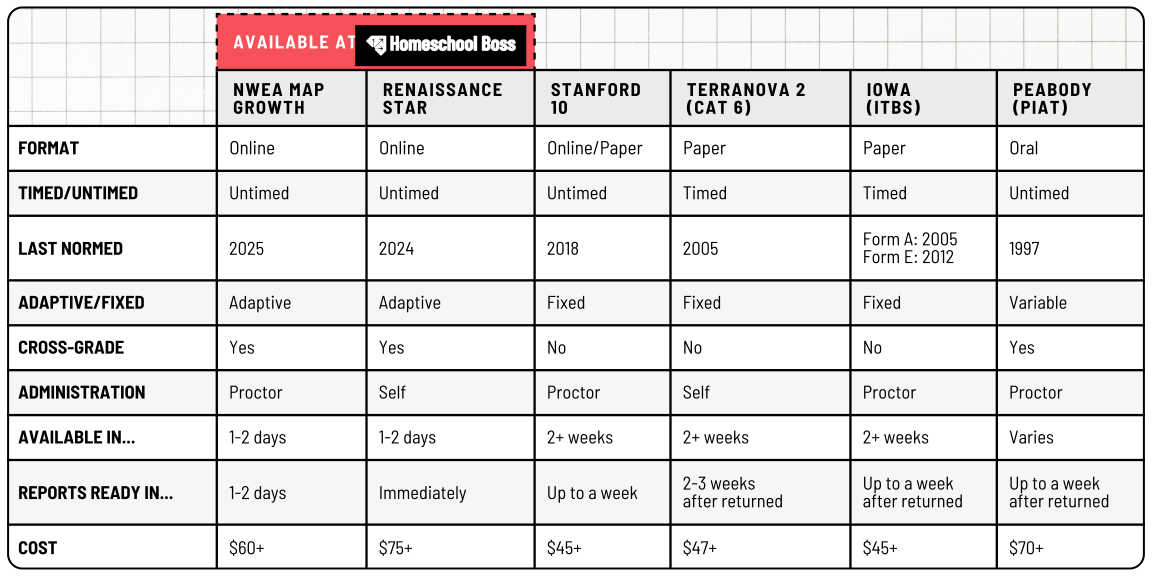
When was the test last normed?
It matters how recent your test of choice participated in a norming study.
Norms are an important part of scoring homeschool standardized tests.
When a child takes a traditional classroom test, their score will usually tell you what percentage of the questions they were able to answer correctly. When standardized tests are scored, the child’s performance is compared to the results of other kids in the same grade at the same time of year who participated in the norming study. The group used for comparison is called the norm group.
Examples:
- If a student answers everything correctly, they will get 100%. If they miss one out of four questions, they’ll get 75%, etc.
- If the student performs better than half the kids in the norm group, they would be in the 50th percentile, etc.
- If they perform better than everyone in the norm group, they would be in the 99th percentile.
If the norm group is a good representation of the child’s age-mates, then percentile ranking can give useful information about how the child is performing in comparison to their traditionally schooled peers.
Reputable test publishers are careful to assemble norm groups that represent school populations at the time of publication. However, if a lot of time has passed since the norming study was conducted, the percentile rankings can be misleading, because kids are taught more math now than they were decades ago.
Data from the National Assessment of Educational Progress shows that an average 4th-grade math score in 1990 would be in nearly the bottom fifth today and an average 8th-grade math score from 1990 would be in the bottom third today. If your child has taken a standardized test and you’ve gotten results that seemed unreasonably high, out-of-date norms may be the explanation.
Is the test timed or untimed?
The difference between a timed and an untimed homeschool test is simple — a timed test has a time limit, while an untimed test does not.
If the goal of testing is to measure what your child can do, rather than how quickly they can do it, an untimed test is a better choice. In addition, because homeschool kids are less accustomed to working with strict time limits, an untimed test can be more comfortable for them.
Sometimes homeschool families will select a timed test, and then administer it as if it were an untimed one. This can be appropriate for some students with special needs. However, if the student wouldn’t qualify for an accommodation, it’s a form of cheating that will likely lead to a higher score than is accurate.
Is the test adaptive or fixed?
When students take an adaptive test, the difficulty of the questions adapts based on the student’s performance.
This means the test will become more difficult when a student answers questions correct and less difficult with incorrect answers. The difficulty of the questions adjusts to provide the right amount of challenge to all students. This feature makes adaptive tests more accurate than traditional fixed tests where all students answer the same questions.
How is the test taken?
Most homeschoolers take standardized tests on a computer or on paper.
Tests Administered on Computer or iPad
● Tests are taken online at home or wherever you’re most comfortable
● Convenient and simple process for parents and kids
● Text-to-Speech and other built-in accessibility tools designed to help older students with special needs test independently
Tests Administered on Paper
Requires scheduling testing around when the testing service has booklets available, waiting for the materials to arrive, dealing with used materials, filling in the bubbles, and then waiting for the results (sometimes for weeks).
Test Comparison Chart