


Academic assessments that we use to monitor our children’s progress measure what a child has learned or mastered, compared to a large sample of other children across the nation. This can be very helpful, and it’s often legally required by the states we homeschool in. However, many homeschooling parents and tutors are left with a big question: Why are students better at some subjects and worse at others? The reason this question gets asked is because tests that measure what a child knows is not assessing why a child excels. The test was never designed to answer that question. Cognitive assessments on the other hand are designed to assess the skills individuals use to think and learn. In this blog, we will explore what cognitive assessments are, why they are important, what information you might receive and how you might use that information.
What is a Cognitive Assessment?
Unlike other tests, a student doesn’t need to study before taking this test. A cognitive assessment in its most basic terms is measuring how your brain approaches problems, otherwise known as your cognition. Cognition includes things like complex reasoning, a student’s working memory, their speed, and executive functioning. You can learn more about these cognitive abilities aquí.
Assessment works by presenting seemingly basic questions, tasks, or puzzles to a student. Each task or puzzle challenges different cognitive skills. Cognitive assessments used to be limited to assessing problems with mental functioning. Often, these assessments would be performed by a school or private psychologist. Research suggests cognitive skills are the strongest single predictor of academic achievement. Cognitive strengths based assessments should be available to all children to understand why they learn the way they learn.
What is the Difference Between Cognitive and Academic Tests?
Cognitive assessments are not used in place of academic assessments, they both serve different purposes.
Academic assessments allow you to assess what your students know, and their proficiency in subjects over time. Often, you want to take tests like these multiple times a year to see if your child is progressing in subject areas.
Example questions:
- 34-7=?
- What is the capital of Argentina?
Cognitive assessments are generally taken every few years because the way a student learns is often more static than what they learn. Cognitive assessments are also used to identify learning disabilities. They are also used to pinpoint a specialized learning plan for each student so that they receive education that is informed by the way that student learns.
Example tasks:
- Listen to a short list of unrelated words (apple, couch, cat) and repeat them back immediately, then try to remember them again 5 minutes later.
- Interpret a simple chart
Assessment works by presenting seemingly basic questions, tasks, or puzzles to a student. Each task or puzzle challenges different cognitive skills. Cognitive assessments used to be limited to assessing problems with mental functioning. Often, these assessments would be performed by a school or private psychologist. Research suggests cognitive skills are the strongest single predictor of academic achievement. Cognitive strengths based assessments should be available to all children to understand why they learn the way they learn.
Cognitive Assessment Example: Mindprint
The Mindprint assessment is a peer-reviewed assessment developed at the University of Pennsylvania Medical school for scientists in the NASA program. The mindprint cognitive assessment takes about an hour, and prompts students with simple puzzles that get harder or easier based on how they perform.
Once a student begins the Mindprint assessment, they will be prompted to complete tasks or puzzles. For each task or puzzle. The directions are clear, and before starting each task, they receive a practice question or example. Tasks and puzzles change every few minutes, so even younger children often are not bored. However, the best results, meaning the most comprehensive and accurate results, come from students who were able to have a distraction-free test environment (quiet, with headphones, without other children or adults in the room distracting or helping them.)

Once a student completes the 1-hour assessment, Mindprint provides a wealth of information through their Learner Profile about how that child’s mind works and their performance compared to standardized and normative data in your child’s age group. The MindPrint report comes with detailed explanations of each cognitive skill (complex reasoning, a student’s working memory, their speed, and executive functioning) and provides next steps for how the student can utilize strategies to reinforce or improve their skills.
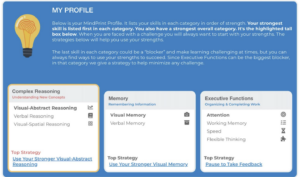
After you take a report like Mindprint, you receive a wealth of information and strategies to understand how your child learns the way they do. Once you have the information, you can put it to use in several ways.
- Find the strengths and lean into them. Using a cognitive strengths based approach allows your student to not be discouraged, rather than only focussing on growth areas. Try to find ways to use your students strengths to learn in new ways.
- Look for patterns. Review the subjects that your student excels at or struggles with and then review the cognitive test. Are there any similarities or differences that might be drawn? Review how your student has done over the last few years and see if you can find any patterns in struggles that connect to their cognitive skills.
- Match your curriculum. After you find your strengths and have identified any critical patterns in how your student learns, it might be time to adjust how you are learning together, using the information provided.
- Share with tutors and co-op or microschool leaders. Information only helps if you use it, and if other teachers or tutors work with your student, having information like this can be transformational.
Curious whether Mindprint is a good fit for your family? Reach out to our team and we’ll help answer any questions you might have.