



This month, the treasury secretary released updated rules for the first Federal School Scholarship Program. This program, funded through a tax credit, allows individuals to donate to organizations that will disperse the funds at a local level.This funding is one among a slew of state-level policies that have been introduced over the last five years that have provided a staggering amount of funding for families. Many families have used this funding to opt into homeschooling. As more students use policies like these to move from public school to homeschooling, the debate over who should receive this money is increasingly shaped by a caricature of homeschooling looming its ugly head and that caricature doesn’t fit the numerous families actually making the choice to homeschool. In this article, we’ll unpack what that trope is, why it exists, and why that matters.
The Caricature That Doesn’t Fit: Who Homeschools?
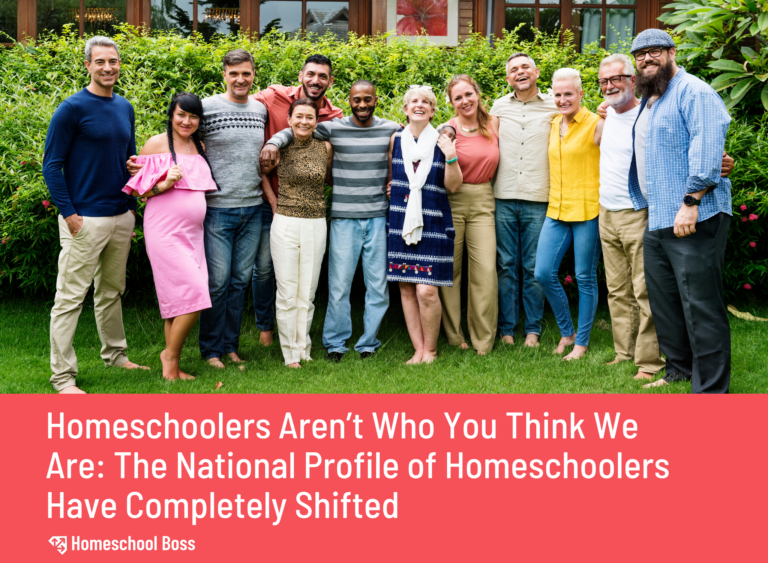
Many people think of homeschoolers and they imagine hyper-religious, anti-government, white, and radical. This trope of who homeschools is as uniformed as it is convenient. More and more educational policies have been introduced at the state and national level that require us to grapple with complex pros and cons of state funds supporting private and non-traditional education. Simple answers about who gets what and who gets to decide what don’t readily exist. Homeschooling has gone purple and many families across the spectrum are utilizing, supporting, and grappling with funding that has led many students to gain access to homeschooling who previously hadn’t in the past.
This narrow understanding of homeschoolers doesn’t represent the vast number of families who have chosen to educate their children at home, nor the various reasons and motivations that individuals choose to do so. Homeschoolers are heterogenous, that is, they represent a wide range of political, racial, and religious groups. In fact, homeschoolers are the fastest-growing educational group in the nation. As the pool of homeschoolers have grown, their identities now reflect a new constellation of identities and ideologies across the United States.
Why Does This Trope Exist?
Anyone who homeschools knows that most people don’t understand what homeschoolers do. We are inundated with misperceptions and assumptions about what it means to homeschool our children, and somehow people always feel comfortable asking invasive questions or telling us their opinions. It’s an unsurprising fact then, that people have no idea who homeschoolers are.
The zeitgeist’s understanding of most groups of people are rarely nuanced, and it rarely changes at the rate of reality. Homeschooling is no different. Homeschooling was, for many years, a majority a white, christian and conservative group, but it was never uniformly so. During the 2010s, homeschooling began to popularize more broadly, but during Covid and in following years, a staggering number of students switched to homeschooling and never looked back.
At the same time, many educational policies have begun to emerge at the state level. These policies generally support homeschoolers, and are also often met with resistance and criticism that pulls in the caricaturizing of homeschoolers in its dialogue. This is unfortunately all too common. Politics often evokes tropes, because they are easier to digest than a nuanced understanding of a topic or a group of people.
We Aren’t Who You Think We Are
Necessary and important debates are occurring about school choice policies, especially in the lead up to midterms. As you learn about policies, their pros and cons, be careful to listen for flattening where there may be nuance and caricaturization of homeschoolers when it’s politically convenient. These policies are being fought for by people who believe they already know who homeschoolers are. Some will see allies, others will see adversaries, and almost none will be picturing the unique families with a wide array of needs and priorities that make up homeschooling.
So, why did you start homeschooling? Share your story in the comments!
Como siempre, continuaremos proporcionando información simple y clara sobre las noticias y cambios de políticas nacionales de educación en el hogar. Actualizamos nuestro blog semanalmente todos los lunes, así que asegúrate de revisar regularmente las últimas noticias sobre educación en el hogar con ideas prácticas para las familias.